
Nueces Projected Versus Actual Release
The Texas Department of Criminal Justice calls its public field the Projected Release Date. TDCJ defines it as the date calculated by its Classification and Records Office for a person to leave incarceration if parole does not occur sooner. The field is a forecast based on the record as it stands. It is not an appointment at a gate, a promise of community release, or proof of full discharge from the sentence.
An actual release is a completed custody event. Staff must process the governing order, check warrants and detainers, settle the destination, and record the exit. A person can leave a TDCJ prison on parole or mandatory supervision yet remain under legal supervision. A maximum expiration or discharge has a different meaning. At the county level, an exit may instead be bond, time served, completion of a county sentence, transfer to TDCJ, or delivery to another authority.
A pretrial Nueces County Jail detainee generally has no computed sentence-release date. Bond may become available, a judge may enter an order, charges may change, or another hold may remain. The Nueces criminal docket gives the legal context, but the NCSO custody event supplies the physical exit or transfer. Those two records should be read together.
Find a Nueces Release Date
Start with the custody system, not the county of conviction. TDCJ is the right source only for a person who entered Texas state prison. NCSO and the Nueces court record cover a county booking or county sentence. A federal pretrial detainee may be under the U.S. Marshals Service even when held locally, while a sentenced federal prisoner is searched through the Bureau of Prisons. ICE has its own locator when immigration custody begins.
- Identify the custodian. Confirm whether the person is in the Nueces County Jail system, TDCJ, federal custody, or ICE custody. A transfer is not a community release.
- Match stable identifiers. Use an SO or booking number for NCSO, a TDCJ or SID number for state prison, or a court cause number. Compare date of birth and offense data when names are common.
- Read the governing record. For TDCJ, compare status, location, projected release, maximum sentence date, offense, and county or case data. For a county sentence, obtain the judgment and jail-credit terms.
- Use a second channel. TDCJ provides online, email, and telephone inmate-information routes. NCSO Jail Information and a written public-information request are the county fallbacks.
- Confirm the exit. Check the completed release or transfer event and its destination. Do not convert a projection, court setting, or favorable parole vote into an actual release.
The TDCJ Online Inmate Search is the first state-prison channel. Search by TDCJ number or SID when possible. Otherwise, use last and first name, review candidates, and compare age, offense, and case details. If the web result is absent or unclear, TDCJ's Inmate Information page provides email and phone routes for public location, offense, and projected-release information.
For county custody, call NCSO Jail Information at (361) 887-2300 and ask whether the booking is still held, released, or transferred. A written request should seek existing fields such as booking number, sentence calculation, jail credit, release date and time, release code, and receiving agency. The District Clerk register can supply the sentence, bond order, dismissal, or commitment that explains the calculation, but it may not show the moment staff finished processing.
TDCJ Dates for Nueces Prisoners
A person convicted in Nueces County may serve a state sentence elsewhere. No TDCJ prison unit was identified in Nueces County's official facility map. Therefore, location and county of conviction can differ, and the statewide TDCJ record is more useful than looking for a local prison page.
The public record should be transcribed exactly. A projected release date may be earlier than the maximum sentence date, but neither field should be read alone. Status and location may show that the person remains confined, has entered parole processing, or has left prison under supervision.
| TDCJ field | What it helps establish |
|---|---|
| TDCJ or SID number | Distinguishes the correct record from people with similar names. |
| Status and location | Shows the current state-system placement or public status supplied by TDCJ. |
| Projected release date | Shows the current Classification and Records forecast if parole does not occur sooner. |
| Maximum sentence date | Marks the maximum-expiration point shown in the state record, subject to other custody. |
| Offense and case data | Helps verify identity and determine which eligibility rules may apply. |
The official TDCJ definitions explain these labels. The captured reference below is useful for recognizing the agency's terms rather than inventing a date from a sentence length.
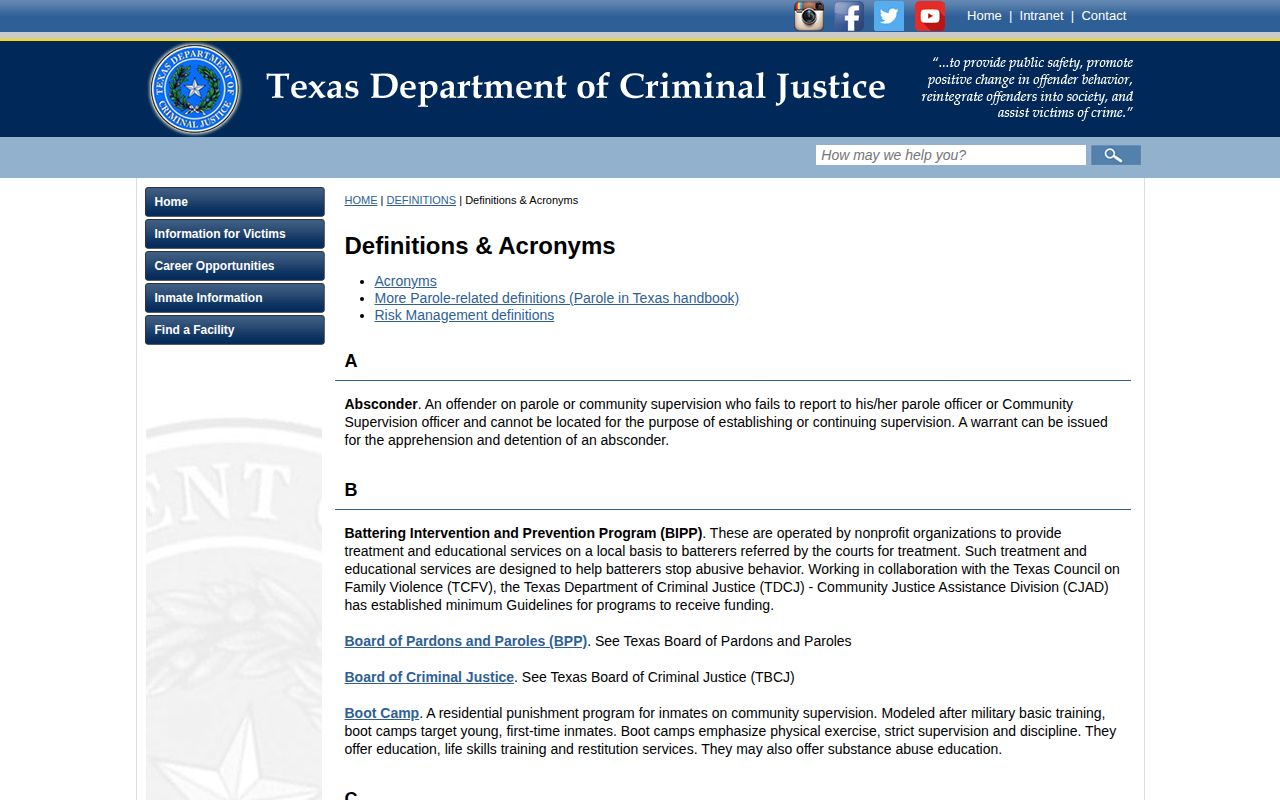
The definition makes the key limit plain: the projection comes from TDCJ's calculation and can change when the legal or custody record changes.
Nueces Release Dates and Good Time
Texas Government Code Chapter 498 governs good-conduct time in the state system. Good time may affect eligibility for parole or mandatory supervision when the governing law allows it. Classification and credits can also be reduced, forfeited, or restored. Good time does not shorten the sentence imposed by the court itself, and it does not guarantee that the Board of Pardons and Paroles will approve release.
TDCJ describes several broad calculation paths. For eligible offenses committed before September 1, 1996, flat time plus good time may reach the sentence term. For eligible later offenses, discretionary mandatory supervision also requires Board approval. If an offense is not eligible for mandatory supervision, the projected date generally matches maximum expiration unless parole occurs first. Offense date and offense type matter, so broad percentage claims are unsafe.
Government Code §508.145(d) applies a different rule to listed serious offenses and specified deadly-weapon findings. It generally requires actual calendar time, without good-conduct credit, equal to one-half of the sentence or 30 years, whichever is less, subject to the statute's minimum rules. Other cases may use actual time plus good time under a one-fourth or 15-year threshold, depending on the precise subsection and exclusions. These are eligibility points, not release dates.
County jail calculations follow another path. Texas law permits sheriff-administered commutation for good conduct in eligible county-jail cases, while the judgment, jail credit, and order terms also control. NCSO did not publish a county daily-credit table or public calculator in the researched sources. Obtain the judgment, then ask NCSO for its existing custody calculation. A TDCJ projected date must never be copied onto a Nueces County Jail sentence.
What Moves Nueces Release Dates
A projection changes when a fact used in the calculation changes or when another authority prevents the expected exit. The cause may be administrative, disciplinary, judicial, or related to parole review. The date can move earlier or later, and the public display may lag behind an agency decision.
| Factor | Possible effect | Best confirmation |
|---|---|---|
| Sentence or jail-credit correction | Changes credited time or the term used in the calculation. | Signed judgment, commitment, and agency calculation. |
| Good-time forfeiture or restoration | May shift eligibility where credit is legally relevant. | TDCJ Classification and Records information. |
| Parole or mandatory-supervision action | Approval may permit an earlier exit; denial may move the projection toward maximum expiration. | BPP decision plus final TDCJ custody status. |
| Detainer, warrant, or new hold | May cause transfer to another custodian instead of community release. | Custody-event destination and the holding agency. |
| Concurrent or consecutive sentence | Changes how multiple terms run against each other. | Court judgments and agency sentence record. |
| Required program or data correction | Can delay processing or revise a displayed date. | TDCJ review and release-processing channels. |
A favorable BPP vote is also not a gate date. An approved plan, required program, detainer check, or other processing step may remain. Parole is physical release from prison into continued legal custody and supervision, not final discharge. The responsible parole office may depend on the approved residence rather than Nueces County as the county of conviction.
Nueces County Has No Calculator
No official NCSO public release-date calculator or county-specific daily good-time schedule was found. That absence matters. Adding a sentence length to a booking date ignores presentence credit, the signed judgment, eligibility, concurrent or consecutive terms, holds, and the sheriff's own calculation. It can produce a confident but false date.
Request the judgment and jail-credit language from the Nueces District Clerk. Then ask NCSO for the existing projected completion or release calculation tied to the same SO or booking number. If the person is pretrial, ask about custody status and the controlling order instead of asking for a sentence-release forecast. If NCSO transferred the person to TDCJ, start a new state-system timeline at TDCJ intake.
No Nueces-specific weekend or holiday release policy was found either. Processing may be affected by lawful schedules, but family pickup plans should not be built from an assumed early release. Jail Information can confirm the current custodian and route a narrow question about a named pending event.
Confirm Nueces Actual Release
Close the loop with an actual custody event. For a county booking, preserve the NCSO notification if one arrives, check the criminal case register, and request the release or transfer record when durable proof is needed. For TDCJ, compare the offender record with the Board action and any parole status. A date that has passed, disappeared, or moved is not enough by itself.
Texas now uses IVSS-Counties for participating county custody notifications and a separate TDCJ IVSS for state custody and parole or mandatory supervision. These are alert channels, not certified records. The VINE Inmate Check explains the current IVSS route and the limits of a no-result. Federal and ICE custody require their own systems.
- Projected release
- A current agency forecast, not a completed exit.
- Parole
- Release from prison while the person remains under legal supervision.
- Mandatory supervision
- A statutory form of supervised release whose eligibility and approval depend on the governing law.
- Discharge
- The end of the sentence or supervision reflected by the official record.
- Detainer
- A request or hold that can send a person to another custodian instead of the community.
Keep county, state, federal, and immigration events in one dated timeline. That method separates a true release from an internal move or agency handoff and prevents a projected date from being mistaken for what actually happened.